Zhengyang Wang · Personal website
Skip to content
Zhengyang Wang / 王正旸
AboutResearchNewsApplyingLifeCV

Search website

Browse profile and research

AboutAbout Zhengyang WangI am a Computer Science and Technology undergraduate at Beijing Normal-Hong Kong Baptist University, with expected graduation in June 2027. My research experience covers computer vision, mobile RGB-D measurement, hydrological modelling, multimodal reasoning, indoor localisation and cardiac image segmentation.ResearchMapAgent: Indoor Localisation and Spatial ReasoningMapAgent is an ongoing final year project exploring language-model agents for indoor localisation and spatial reasoning.ResearchMetroHeight: Mobile RGB-D Cargo Height EstimationMetroHeight explores smartphone RGB-D sensing for cargo-height measurement on delivery trolleys in metro stations.ResearchHydrological Constraints on Post-Fire Vegetation RecoveryThis project examines how soil-water conditions relate to vegetation recovery after the Gospers Mountain megafire.ResearchSpatiotemporal Flood Forecasting and Hydrological ModellingThis project studies regional river-discharge forecasting through hydrological observations and spatial information.ResearchCardiac Segmentation and Spatiotemporal ModellingST-Net studies cardiac cine MRI segmentation using temporal information when segmentation labels are limited to selected cardiac phases.ResearchVisual Metaphor and Multimodal ReasoningThis project studies visual metaphor generation and reasoning in multi-agent communication games through MetaVision-DB and MACH.ResearchResearch and Development of Third-Generation Intelligent Arrow Selection Equipment and SystemsData-driven arrow selection connects visual measurements with shooting performance. This work supports the analysis of arrow dispersion and stability across rounds.

Search is processed on your device. Press Esc to close.

中文
AboutResearchNewsApplyingLifeCV
Research Projects

03 / 07 · Ecohydrology · Remote sensing

Post-Fire Recovery

Hydrological Constraints on Post-Fire Vegetation Recovery

This project examines how soil-water conditions relate to vegetation recovery after the Gospers Mountain megafire.

Role
Hydrological and vegetation data analysis · Second author
Period
Oct 2025 – Sep 2026
Research areas
Ecohydrology · Remote sensing

Poster abstract accepted · BES 2026

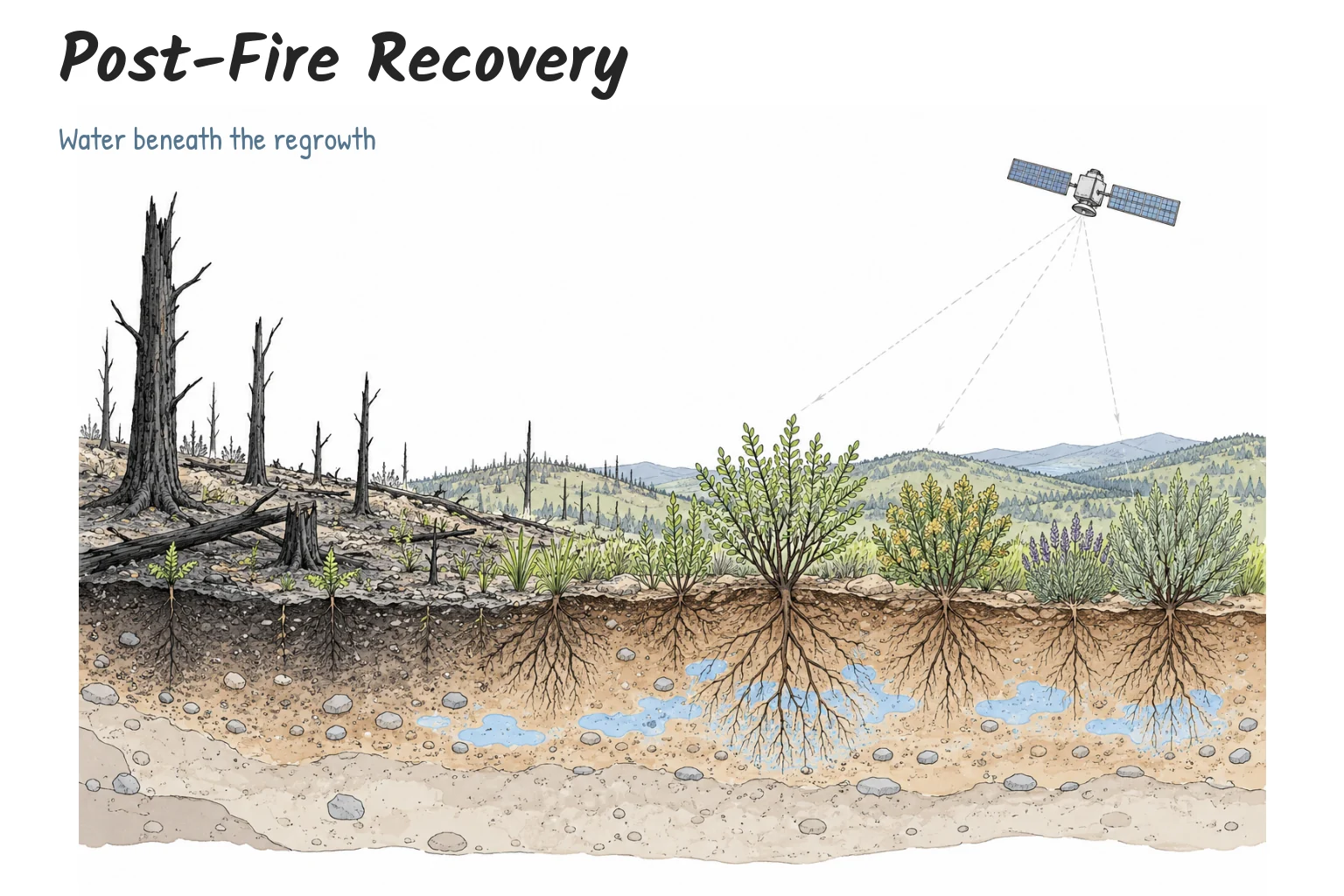
Hand-drawn post-fire vegetation and a soil-water cutaway
View illustrationEnlarge

Image viewer

100%
1 / 2

Hand-drawn post-fire vegetation and a soil-water cutaway. Conceptual illustration.

Scroll to pan · + / − zoom · 0 reset · Esc close
Hand-drawn post-fire vegetation and a soil-water cutaway. Conceptual illustration.

Contents

OverviewHow it worksSelected contributionsResearch status
Contents
OverviewHow it worksSelected contributionsResearch status

Overview

Understand hydrological constraints on vegetation recovery after major disturbance.

How it works

Modelled soil saturation and MODIS NDVI are aligned over comparable periods before and after the Gospers Mountain fire. The analysis separates long-term trend agreement from year-to-year variation during recovery. These associations describe hydrological and vegetation behaviour; they do not by themselves establish a causal effect of soil water on recovery.
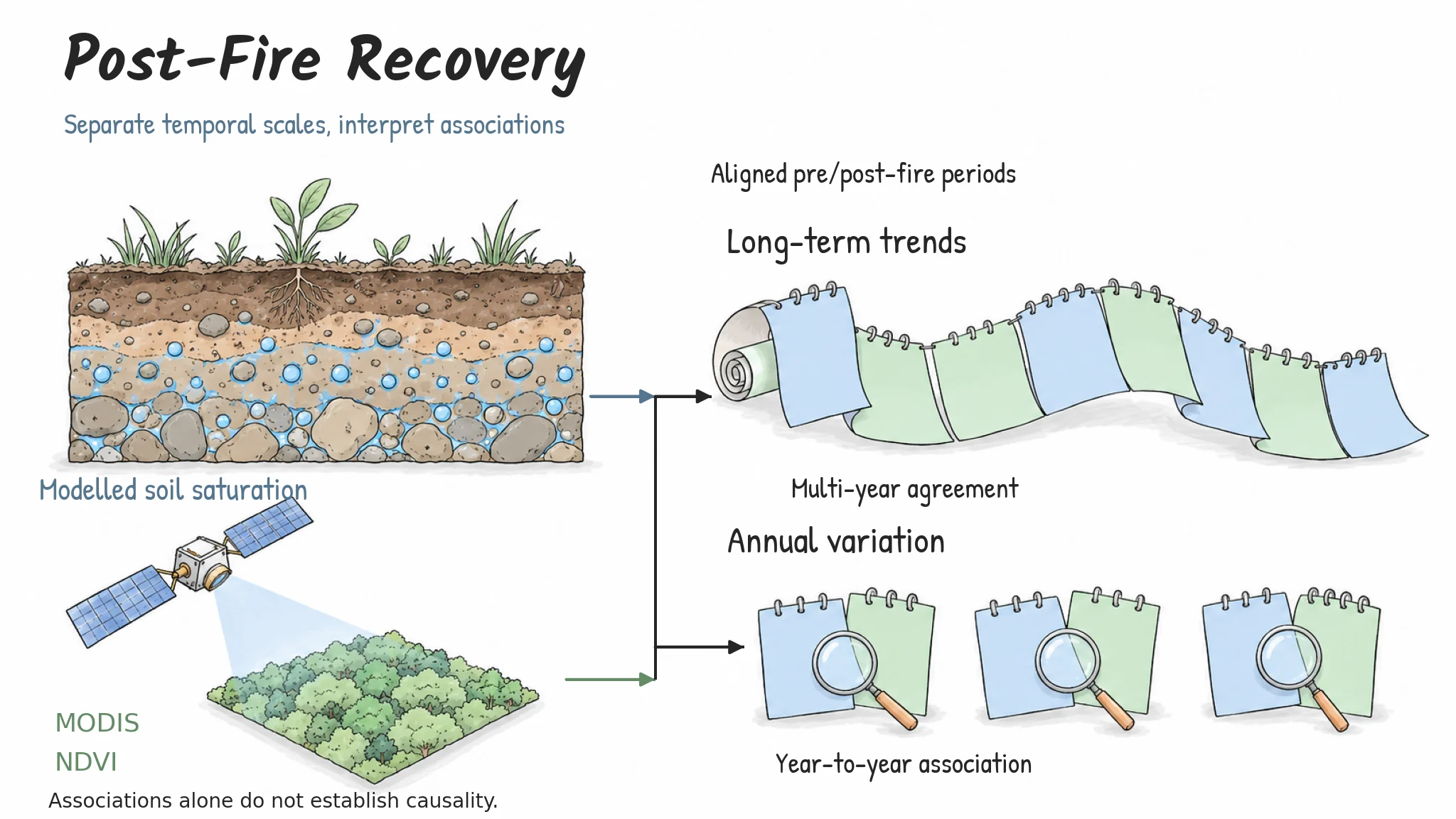
Modelled soil saturation and MODIS NDVI are compared at two temporal scales. Long-term trend agreement and year-to-year association answer different questions; neither panel presents numerical results or proves causality.
View illustrationEnlarge

Image viewer

100%
2 / 2

Trends and annual variation — Modelled soil saturation and MODIS NDVI are compared at two temporal scales. Long-term trend agreement and year-to-year association answer different questions; neither panel presents numerical results or proves causality.

Scroll to pan · + / − zoom · 0 reset · Esc close
Trends and annual variation

Modelled soil saturation and MODIS NDVI are compared at two temporal scales. Long-term trend agreement and year-to-year association answer different questions; neither panel presents numerical results or proves causality.

AI-assisted method illustration

Selected contributions

  • Analysed soil-water and satellite vegetation data before and after the fire.
  • Distinguished long-term trend agreement from year-to-year relationships during recovery.

Research status

Second author of “Long-term hydrological support constrains vegetation recovery after major disturbance”; abstract accepted for in-person poster presentation at BES Annual Meeting 2026.

Next Project

Flood Forecasting

Zhengyang Wang

Computer Science and Technology · BNBU

EmailGitHubCVPersonal Profile
© 2026 Zhengyang Wang · 王正旸Built on Magic UI PortfolioBack to top ↑